Afghan Refugees in Pakistan are facing growing uncertainty following new government directives ordering relocations and deportations. Among those affected are Afghan Christians supported by Philoi Global, who report increasing risks of arrest, homelessness, and forced return to Afghanistan – where they will be persecuted because of their faith.

John works with Philoi Global as a migration agent, and pastorally cares for Afghan Christians who are forcibly displaced in Pakistan. Many left Afghanistan after the Taliban takeover in 2021.
Every day, he receives desperate updates from these communities. They face homelessness, sexual violence, hunger, arbitrary arrests, and deportation orders.
"Hello dear brother, I hope you are in good health.
I think you are aware of the terrible situation of Afghan refugees in Pakistan. Everyone is fleeing and relocating to save their lives and to avoid forced deportation back to Afghanistan. I, too, must relocate with other brothers and sisters of Christ.
Please pray for the solution of the problems of us believers at risk in the full name of Jesus Christ. Amen."Ahmad*, Afghan Christian seeking refuge in Pakistan, February 2025.
The Concern
Philoi is currently supporting around 160 Afghan Christian families in Pakistan. We know that thousands of other persecuted ethnic and religious minorities are also at risk.
These families face life-threatening dangers because of their faith, ethnicity, nationality, and political beliefs. Deportation would expose them to extreme persecution under both the Pakistani and Afghan regimes.
A Dangerous Government Directive by Pakistan
On January 29th, 2025, the Pakistani Prime Minister’s Office issued a circular order demanding the immediate repatriation of those with:
ACC cards (Afghan Citizen Cards) and
POC card holders (Pakistan Origin Card) holders from Islamabad and Rawalpindi.
These documents were meant to offer some protection, but now they are used to identify and deport vulnerable individuals.
Escalating Tension and Forcibly Displaced Afghans
The conflict between Afghanistan and Pakistan continues to escalate, with cross-border attacks and violence involving groups like the Pakistani Taliban (TTP) and the Balochistan Liberation Army (BLA).
Since the Taliban’s return to power in Afghanistan in 2021, attacks have been intensified, making the region even more dangerous for those being deported.
"Just a couple of days ago, my son was arrested and interrogated for a day. He was only released after we paid a heavy bribe. There are extreme risks in Pakistan as Afghan refugees - the authorities have become increasingly aggressive, and the risk of arrests and deportation has grown by the start of 2025."
Mina*, aged 25.
UNHCR’S Inaction and Limited Protection
The UNHCR confirmed in a statement on the 1st of February 2025, that even Afghan nationals with valid Proof of Registration cards (POR) must leave Islamabad and Rawalpindi.
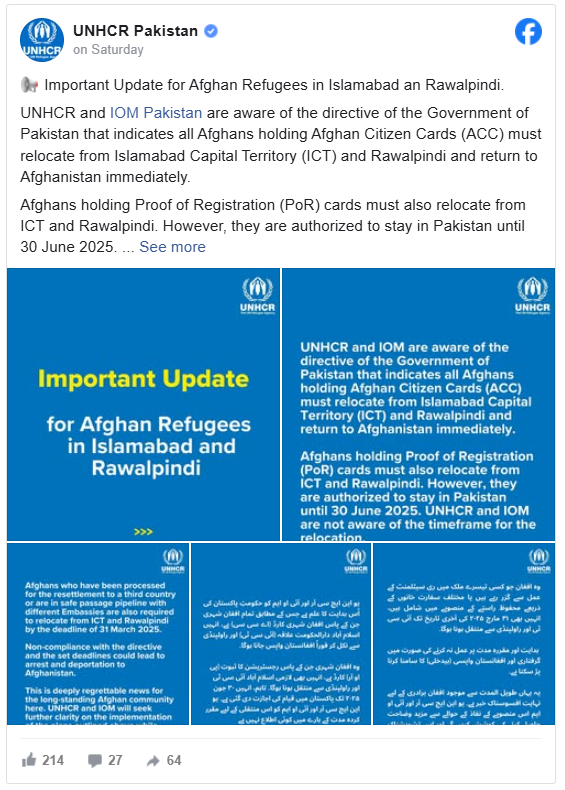
Sadly, this is not the first time Pakistan has forcibly deported refugees while the UNHCR failed to provide adequate protection.
It is deeply troubling that countries like Australia continue to rely on the UNHCR for refuge resettlement, despite its inability to safeguard persecuted minorities.
Resettlement is not a simple or viable solution immediately; over 44,000 Afghans in Pakistan are approved and await relocation to Western countries, and around 25,000 are hoping to be resettled in the U.S. However, the U.S. has suspended its resettlement program – leaving these Afghans in limbo.
"Pakistan is serious about the deportation of refugees. I hope that the pressure of governments, human rights organizations and international organizations supporting refugees can influence the decision of the Pakistan government, and prevent the deportation of refugees."
Ali*, aged 34.
According to Pakistan’s Chief Commissioner for Afghan Refugees, there are 1.4 million registered Afghans and 700,000 unregistered Afghans in the country.
Recently, Pakistan deported over 140 Afghan refugees – men, women, and children, handing them over to Afghan authorities at the Torkham border. One of our contacts reported to us that a young Hazara woman was killed upon arrival in Afghanistan by the Taliban.
"We are staying at home and not going outside unless it is absolutely necessary.
The Pakistani police conduct hose-to-house searches often. We are terrified they will find our Bibles.
I don't know what to do. If we return, we will be killed, or me and my sister will be forced to marry the Taliban members. I don't know what to do. I don't know what to think."Alma*, aged 23.
Help us to sustain families at risk.
*Names have been changed for security reasons.